Country Balls: Power Protocol
- 3.9
- Rating
- 100.00K
- Installs
- Free
- Price

 Analysis by App-foxy
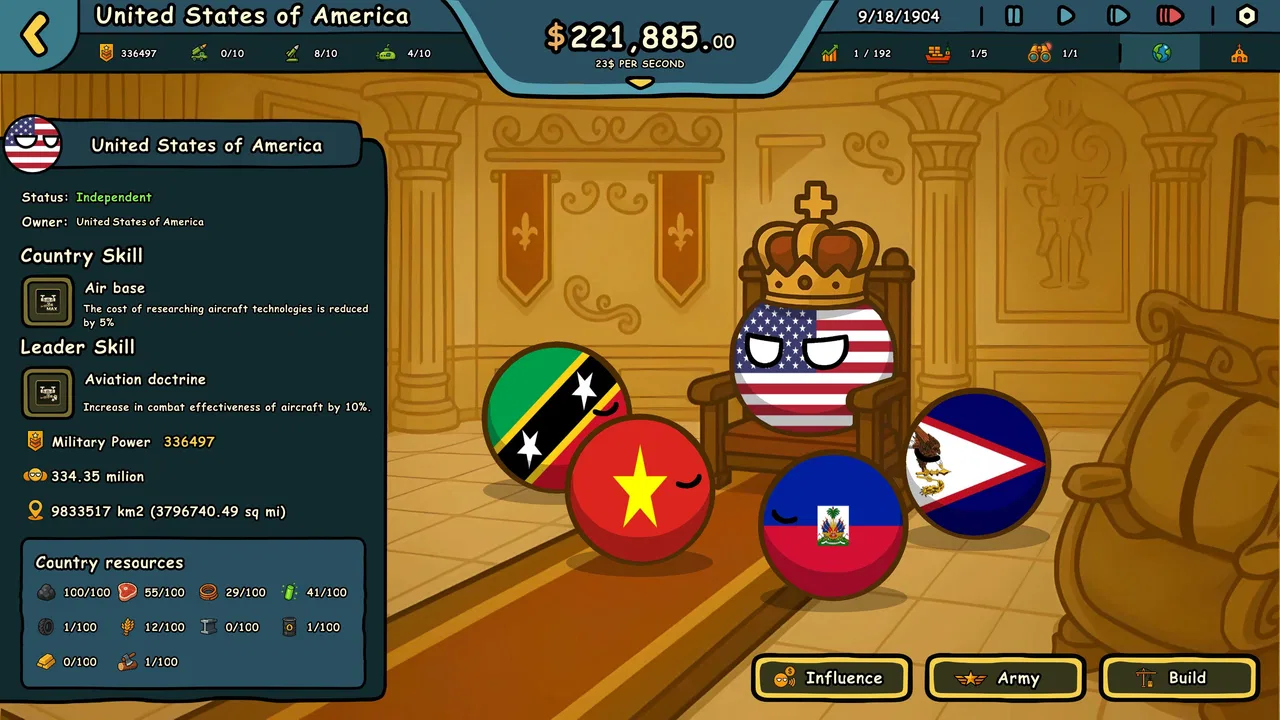
I spent time with Country Balls: Power Protocol as a strategy game on a shared device, and its appeal became clearer in short sessions than in long ones. The central idea is simple: tap, build up a countryball force, and push an empire across the map. That makes it easy to understand when someone else in the household wants to try it, but the simplicity also means you need to decide whether you enjoy gradual progress more than deep tactical planning.
Developed by MAD PIXEL, the game is free to install and aimed at a Teen audience. Its current version is 0.2.1, and it runs on Android from version 7.1 onward. The store listing places it in the strategy category, although my experience is closer to a light, accessible strategy game than to a complex war simulator. I would recommend trying it if you like watching a small force grow through repeated actions, but I would not choose it for a household looking for a highly detailed multiplayer strategy experience.
How it works on a shared household device
The best shared-device use case is a quick handoff between people who want to make progress without learning a large rulebook. One person can build for a while, another can continue expanding, and the game’s countryball presentation keeps the tone playful rather than grim. I can imagine it working during a short break, on a family tablet, or when one person has finished a turn in another game and wants something immediately understandable.
You May Also Like

 Blood Strike: 2.5 Anniversary
Blood Strike’s Loadouts Turn Every Drop Into a Tactical Gamble
A close look at Blood Strike’s custom loadouts: how fast access to signature weapons reshapes its battle royale rhythm, rewards preparation, and narrows the gap between fights.

 Pandora - Music & Podcasts
Pandora’s Music Is Easy to Start, but Harder to Recover
Pandora’s strength is its low-effort path from a seed to a station. Its weak spot is how much confidence it asks you to place in connection, setup, and quiet recovery.

 8 Ball Pool
 Is Built on Rivalries, Rematches, and Routine
A close look at the rivalries, rematches, shared routines, and unanswered safety questions that turn a quick pool match into a persistent mobile community.

 Samsung Music
’s Quiet Strength Is Playing What You Already Own
Its reach comes less from spectacle than from dependable access to a personal library. That simplicity is both the app’s strongest retention engine and its ceiling.

 AccuWeather: Weather Radar
AccuWeather Review: A Quick, Clear Forecast for Everyday Decisions
For everyday plans, the best forecast is the one you can understand quickly. AccuWeather makes rain timing, radar, and local conditions easy to act on, with a few trade-offs.

 Hill Climb Racing
Why Hill Climb Racing Still Turns Crashes Into One More Run
A tiny car, a bumpy hill and one more upgrade: Hill Climb Racing keeps resurfacing because its simple chaos makes every near-miss feel personal.
More From Our News Desk
View All News


That convenience has a trade-off. The same persistent progress that makes handoffs attractive can blur who is actually making decisions. If several people use one device, a child might spend the stored resources that another player was saving, or change the direction of expansion simply because the game was open when they picked it up. I found it much better to treat the game as a shared project than as several separate profiles. If everyone expects private progress, the experience can become frustrating very quickly.
Before handing over the device, I would agree on a simple household rule: one player controls the next expansion choice, while everyone else can watch or suggest. That sounds minor, but it prevents the most common shared-game disagreement. It also suits the game’s accessible design, because the fun comes from seeing the empire develop rather than from hiding complicated plans from the next person.
A useful routine is to play in small blocks. I would let one person complete a short building cycle, pause to discuss the next target, and then pass control. This keeps the game from turning into an unattended tapping session and gives younger or less experienced players a chance to understand why a decision was made. It also makes the game easier to fit around ordinary household activities, where nobody wants a single player to occupy the device indefinitely.
Setting expectations before the first session
There is no need for a long tutorial speech, but I would explain three boundaries before installing it on a shared phone or tablet. First, decide whether progress belongs to one person or to the household. Second, agree that purchases require permission from the device owner. Third, make clear that removing or reinstalling a game can affect access to progress, so nobody should change the installation casually.
The purchase boundary matters because the game is free to play but includes optional in-app purchases priced from $0.99 to $49.99 per item. I would not leave that conversation until a purchase prompt appears. On a shared device, the important issue is not whether the game can be enjoyed without paying; it is whether every person using the device understands that tapping through a purchase is different from spending ordinary in-game resources.
I also recommend separating “trying the game” from “committing to it.” A first session can tell you whether the tapping-and-expansion loop feels satisfying, but it may not tell you whether the household will still enjoy it after several handoffs. I would play without spending anything at first, observe who actually returns to it, and only then decide whether the game deserves a permanent place on the device.
For a child using a parent’s phone, the practical boundary is the owner’s screen-time routine, not the game’s theme alone. The Teen content rating means I would review the game personally before offering it to a younger child. A cartoon countryball style can look harmless, yet the rating is the clearest signal that families should make their own age decision rather than assuming the visual presentation tells the whole story.
Coordination is more important than speed
When I played with another person nearby, the most enjoyable part was discussing what to build next rather than simply taking turns tapping. That creates a small planning layer: should the current effort go toward strengthening the existing position, or toward opening another path for expansion? Even without treating every move as a serious tactical decision, talking through the choice gives the game more character than playing silently.
For shared use, I would assign roles informally. One person can operate the game, while another keeps track of the household’s agreed goal, such as saving for a particular upgrade or finishing a chosen expansion route. This is not a built-in team system; it is a way to make a simple game feel more cooperative without pretending that it offers formal coordination tools.
That distinction is important for expectations. I did not approach this as a competitive strategy title with the depth of a large empire-management game. The countryball theme and quick actions make it easier to enter, but they also reduce the amount of information a serious strategist may want. If your household enjoys detailed diplomacy, resource chains, map analysis, or long-term multiplayer planning, a more established strategy alternative will probably provide a richer experience.
On the other hand, a complicated alternative can be a poor fit when people have different skill levels. A grand strategy game may leave a new player confused while an experienced player makes every meaningful decision. Country Balls: Power Protocol is more suitable when the goal is to let everyone participate at roughly the same basic level. I especially liked that it can serve as a conversation game: the person holding the device does not need to be the only person who understands what is happening.
My most useful tip is to avoid treating every available action as an obligation. In a shared session, constant tapping can make the game feel like work and can encourage one player to rush ahead. Instead, stop after a visible change in the empire and ask whether the next move is worth making now. This creates natural stopping points and makes it easier for someone else to take over without feeling that they are inheriting a half-finished task.
Progress, spending, and the limits of a shared profile
The free entry point is one of the game’s strongest household advantages. Nobody has to pay before learning whether the core loop suits them, and a family can test it on an older compatible Android device because the minimum operating-system requirement is Android 7.1. That broad compatibility is helpful when a newer phone is reserved for adults and a previous device becomes the shared game screen.
Still, free installation should not be confused with a completely frictionless experience. The presence of purchases means the household needs a clear policy, especially if the device is used by more than one person. I would keep the game’s spending decisions with the owner and ask other players to treat paid options as unavailable unless permission is given in advance. That keeps enthusiasm from becoming an accidental charge.
I also found that a shared profile changes the meaning of progress. In a personal game, a slow upgrade is your own choice. In a household game, it can become a group decision because one person’s patience affects everybody else. If one player prefers saving and another prefers immediate expansion, the conflict is not really about strategy; it is about ownership. Agreeing on that distinction before playing is more valuable than trying to find a perfect build order.
For that reason, I would not use this as a substitute for a game with separate accounts when privacy or independent progression matters. It works best when the people using it trust one another and are comfortable seeing the same empire change over time. If a teenager wants a private strategy project, or if siblings strongly dislike sharing progress, a title with clear profile separation is the safer recommendation.
The game’s average rating is 3.5 from around 1.3 thousand ratings, with roughly 64 written reviews, and it has passed 50 thousand installs. I read those figures as a sign of an early, still-developing audience rather than as proof that it will suit everyone. The version number also suggests that I would approach it with some patience: the core idea is easy to grasp, but the overall experience may feel less settled than a long-established strategy game.
Age, trust, and who should take the lead
The Teen rating changes how I would introduce the game at home. I would let an adult or older player try it first, then decide whether the tone and presentation are appropriate for the younger people who share the device. The countryball artwork makes the premise approachable, but a light visual style does not automatically make a game suitable for every age.
I would also explain that the game represents conquest as a playful objective. That can be perfectly acceptable in a strategy context, yet younger players may need help separating the cartoon framing from real-world history and politics. A short conversation is enough: this is a fictionalized game about expanding an empire, not a lesson in how countries or governments actually work.
Trust matters in another way. A child who is allowed to play independently should know whether they can continue building while an adult is away, and an adult should know whether the device may be passed to someone else. Since the game is built around ongoing progress, unclear permission can lead to arguments even when nobody intended to cause trouble.
I would not present it as an educational geography tool. The countryball theme may spark curiosity about nations, but the game’s purpose is entertainment and progression. If the household wants accurate geography, historical context, or a structured learning experience, a dedicated educational app would be a better choice. Here, the useful family value is discussion and shared decision-making, not factual instruction.
For teens and adults who already enjoy idle strategy loops, the game is easier to recommend. It offers a low barrier to entry and a visual identity that keeps the subject matter less severe. For very young children, players who dislike repeated tapping, or anyone wanting a deep campaign with carefully balanced diplomacy, I would skip it and choose something designed around those needs.
Where it fits beside other strategy games
Compared with a traditional turn-based strategy game, this title asks for less planning before the next action. That makes it friendlier during a busy day, but it also means the satisfaction comes from momentum rather than from outthinking an opponent. I could open it for a short session without needing to remember a large set of systems, which is a genuine advantage on a shared device.
Compared with idle empire games, its countryball identity gives the experience a more recognizable personality. The trade-off is that players who want a huge number of menus, detailed production lines, or elaborate customization may find the structure too light. I would choose it when quick progress and easy handoffs matter more than simulation depth.
It also differs from a competitive online strategy game in the way I would use it at home. Instead of asking everyone to maintain separate schedules or compete against one another, I would make one shared empire the focus. That lowers the pressure, although it removes the privacy and personal ownership that separate accounts provide. The right choice depends on whether your household wants cooperation or independent achievement.
One non-obvious strength is that its simplicity makes disagreement visible. In a complex game, a new player can lose track of why a decision matters. Here, a shared player can usually understand the immediate consequence and participate in the conversation. One non-obvious weakness is the reverse: because there are fewer layers to absorb attention, repeated sessions may expose the limits of the loop sooner than they would in a deeper strategy title.
My household verdict
I see Country Balls: Power Protocol as a reasonable free experiment for a shared Android device, particularly when the household wants something that can be learned quickly and discussed together. I would install it for a teen or adult audience, establish purchase rules before play, and treat the empire as shared property unless the game clearly offers a separate way to keep progress independent.
I would not make it the main strategy game for a family that expects private accounts, serious historical detail, or long-form tactical depth. The Teen rating deserves attention, the optional purchases require an adult boundary, and the shared-progress model can create friction if people have different ideas about how to play. Those are not deal-breakers, but they should shape the setup.
My recommendation is to start with short, no-spend sessions and see whether the household enjoys planning together as much as tapping and expanding. If the answer is yes, the game has a pleasant role as a casual cooperative project. If everyone immediately wants separate saves, deeper choices, or a more competitive structure, another strategy game will be a better fit.
Overall, I enjoyed the approachable countryball presentation and the way it turns a simple empire-building loop into something easy to pass around. Its strongest use is not as a demanding strategy masterpiece, but as a light shared activity with clear boundaries. For a household, the smartest way to play is to agree on ownership, spending, and turn-taking before the first expansion.
FAQs for Country Balls: Power Protocol
01What is the main objective of Country Balls: Power Protocol?
Country Balls: Power Protocol is a strategy game where players control and manage country-themed characters, known as 'Country Balls,' to achieve global dominance. The main objective is to strategize and use each character's unique abilities to conquer territories, form alliances, and outmaneuver opponents in a dynamic and engaging world.
02Is Country Balls: Power Protocol free to play?
Yes, Country Balls: Power Protocol is free to download and play on both Android and iOS devices. However, it does offer in-app purchases for various items and upgrades. These purchases are optional and designed to enhance the gameplay experience, providing players with additional resources or cosmetic items.
03What are the system requirements for Country Balls: Power Protocol?
For Android users, the game requires Android 5.0 or later, while iOS users need iOS 11.0 or later. It is recommended to have a device with at least 2GB of RAM for optimal performance. Ensure you have enough storage space available, as the game may require additional data downloads after initial installation.
04How does multiplayer mode work in Country Balls: Power Protocol?
Country Balls: Power Protocol features a robust multiplayer mode where players can compete against each other in real-time battles. Players can join matches through matchmaking or invite friends to private games. The multiplayer mode emphasizes strategic alliances and tactical gameplay, providing a competitive environment that tests players' skills.
05Are there any safety concerns with downloading Country Balls: Power Protocol?
Country Balls: Power Protocol is developed by a reputable company and is available on official app stores, ensuring it meets standard security protocols. However, as with any online game, users should be cautious of sharing personal information and be mindful of in-app purchases to avoid unintended expenses.
Pros
- Engaging storyline with humorous elements.
- Colorful graphics enhance user experience.
- Intuitive controls for easy gameplay.
- Regular updates with new content.
- Offline mode available for uninterrupted play.
Cons
- In-app purchases can be pricey.
- Occasional ads disrupt gameplay.
- Limited language options available.
- Requires frequent updates for bug fixes.
- Some levels can feel repetitive.

Country Balls: Power Protocol
Gallery